
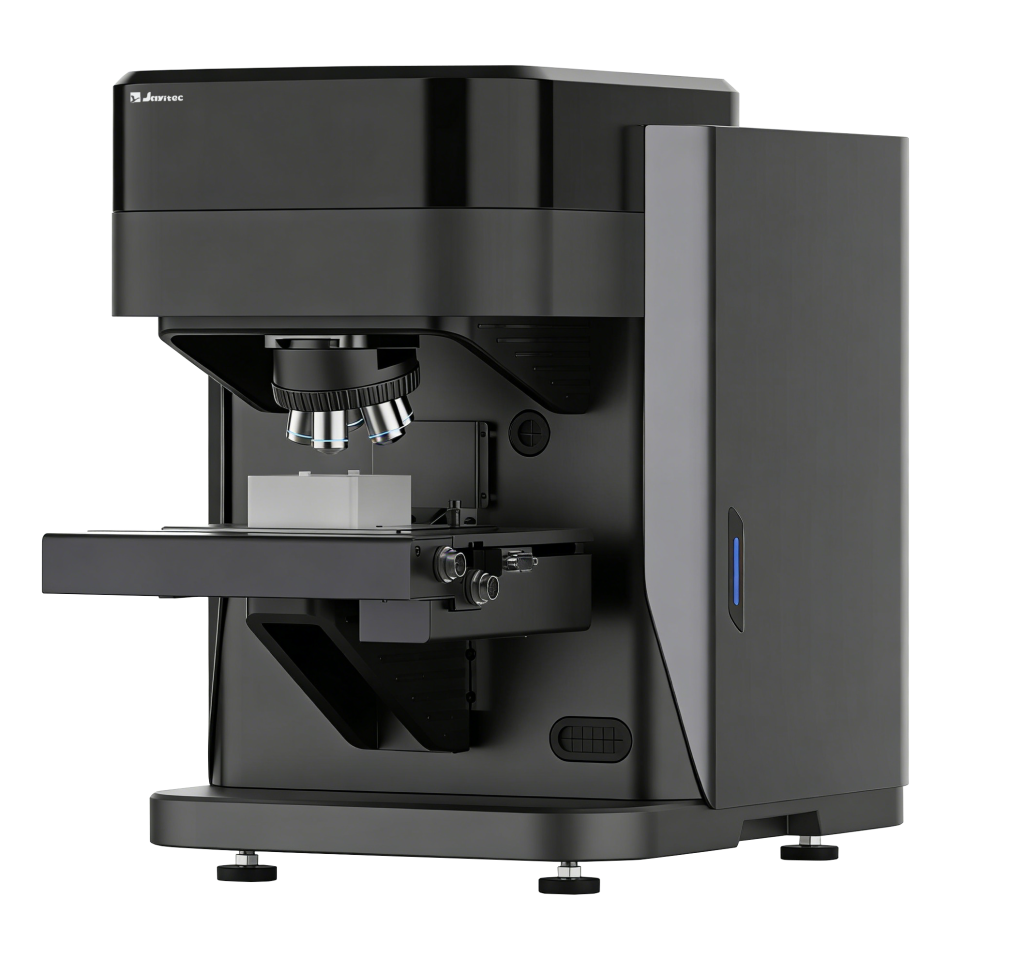
OVERVIEW
In-situ electrochemical Raman spectroscopy is an in-situ characterization technique that combines Raman spectroscopy with electrochemical methods to monitor reactions in real time.
It can track electrode reactions at the molecular level while recording changes in electrode potential/current and Raman signals from interfacial species. In a single experiment, it provides both electrochemical signals and Raman spectral information, supporting both qualitative research and quantitative analysis. With its high sensitivity and selectivity, in-situ electrochemical Raman spectroscopy has become an essential characterization method in materials electrochemistry research.
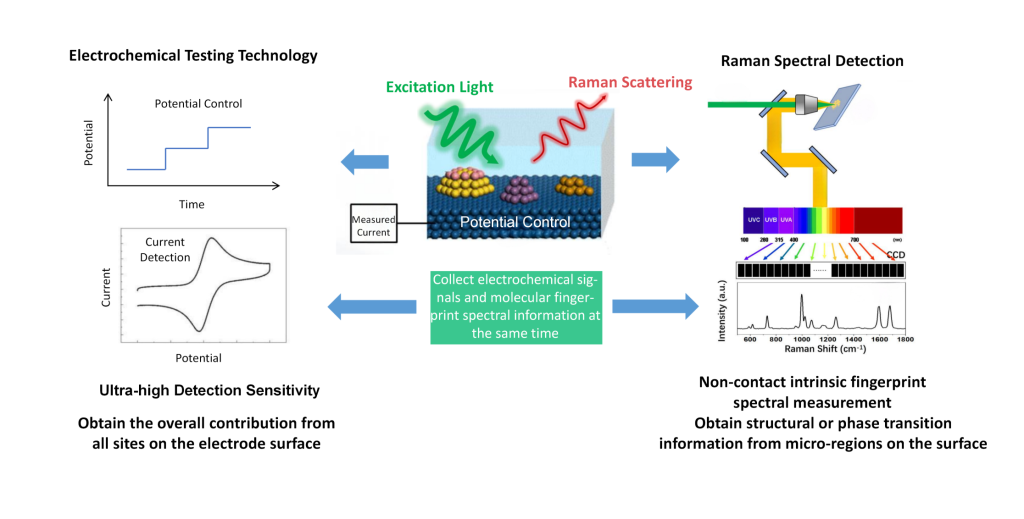
Four key challenges in traditional in-situ Raman limit research efficiency
1.Separated instrument setup
The electrochemical workstation and Raman spectrometer operate independently, making data acquisition difficult to synchronize and increasing experimental error.
2.Separated Software
Each instrument has its own control software, so data from the two systems must be separately integrated and analyzed.
3.Limited Space
The space inside a glovebox is limited, making it difficult to place separated instruments inside at the same time, unable to perform closed-loop in-situ environment testing.
4.Messy wiring
Multiple external cables make the setup complicated, and wiring mistakes can easily lead to experiment failure.
A Breakthrough in Chinese-Developed Instrumentation — EC-Raman Electrochemical Raman Microscope
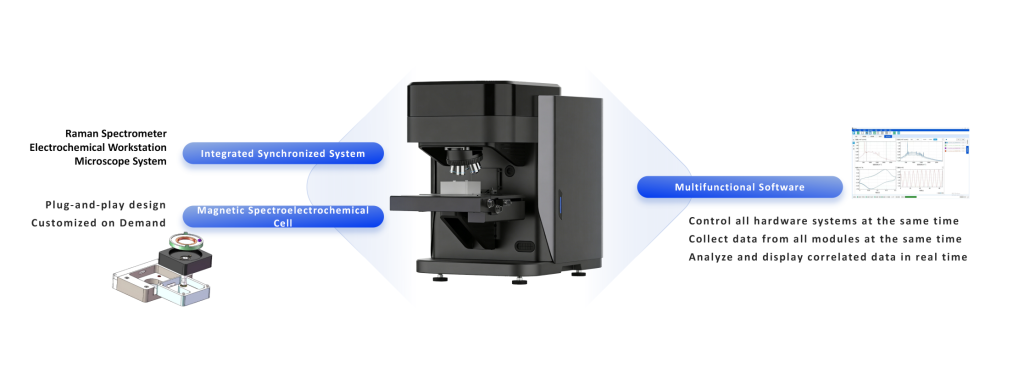
JAYITEC EC-Raman Electrochemical Raman Microscope is the first integrated system in China to overcome the limitations of separated instrument setups. It highly integrates three major systems: microscope imaging, Raman spectroscopy, and electrochemical analysis.
With its compact design, the system can be placed directly inside a glovebox. Combined with intelligent particle recognition, it provides a one-stop solution for in-situ characterization, supporting advanced solution in electrocatalytic mechanisms, energy materials, corrosion science, sensor analysis, and other frontier fields.
Application Case
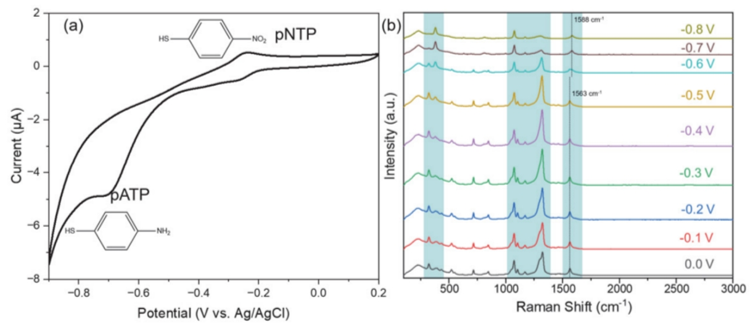
1.Electrocatalytic Mechanism: Electrochemical Reduction of Nitrobenzene Derivatives on Nanogold Surfaces
Through potential control and real-time Raman spectral tracking, the reaction pathway and evolution process can be monitored.
As shown in the figure below, the electrochemical CV curve clearly shows that the reduction current gradually increases as the potential shifts negatively. From the in-situ electrochemical Raman spectra, it can be observed that as the potential shifts from 0 to -0.5 V, the characteristic nitro peak of pNTP at around 1330 cm⁻¹ gradually decreases, while the characteristic peak related to pATP at around 1593 cm⁻¹ gradually increases.
The potential-dependent Raman spectral changes are well consistent with the electrochemical reduction region shown in the CV curve in Figure (a). This directly confirms, at the molecular fingerprint level, that pNTP is electrochemically reduced and converted into pATP under negative potential, enabling electrochemical in-situ SERS tracking of interfacial molecular transformation.
2.Energy Material Characterization: Interface Study During Battery Charge–Discharge Processes
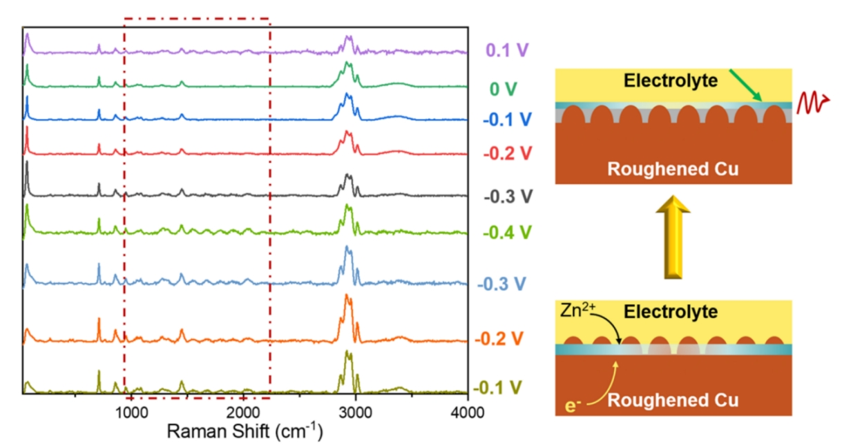
Using potential-controlled in-situ surface-enhanced Raman spectroscopy, roughened Cu is used as both the SERS-enhancing substrate and the working electrode.
In a zinc-based electrolyte system, the system tracks changes at the anode interface in real time within the charge–discharge potential range of 0.1 V to -0.3 V versus the reference electrode. It also monitors the dynamic evolution of electrolyte reduction and decomposition products with changing potential. This helps reveal, at the molecular level, the formation mechanism of interfacial products at the anode/electrolyte interface.
Product Advantages
1.Integrated Synchronized Hardware System
1)Integrates microscopic imaging, Raman spectroscopy, and electrochemical systems in one compact platform, making it suitable for glovebox use and complex experimental conditions.
2)Collects electrode morphology, spectral, and electrochemical information in-situ at the same time, with acquisition delay down to the hundred-nanosecond level.
2.Multifunctional Software Platform
Integrates microscopic imaging, Raman spectroscopy, Raman imaging and electrochemical modules. Electrochemical and Raman data can be displayed in real time on the same interface, directly building a dynamic potential–spectrum correlation and ensuring reliable data.
3.Integrated Transient Electrochemical Raman Characterization
Transient spectra can be collected through synchronous triggering during linear potential scanning, providing information such as apparent electrochemical reaction kinetic constants.
4.Magnetic Spectroelectrochemical Cell
The magnetic electrochemical cell requires no manual wiring and supports plug-and-play operation. It fundamentally avoids electrochemical control failure caused by wiring errors, while also reducing signal disturbance caused by cable stress.
Summary
From complicated separated instrument setup to fully integrated in-situ testing, EC-Raman Electrochemical Raman Microscope is designed to solve the limitations of traditional in-situ Raman systems. With integrated design, easy operation, and high-precision synchronized acquisition, EC-Raman is an ideal choice for in-situ electrochemical spectroscopic characterization, helping accelerate and improve research in materials electrochemistry.