OPTICAL INSTRUMENT

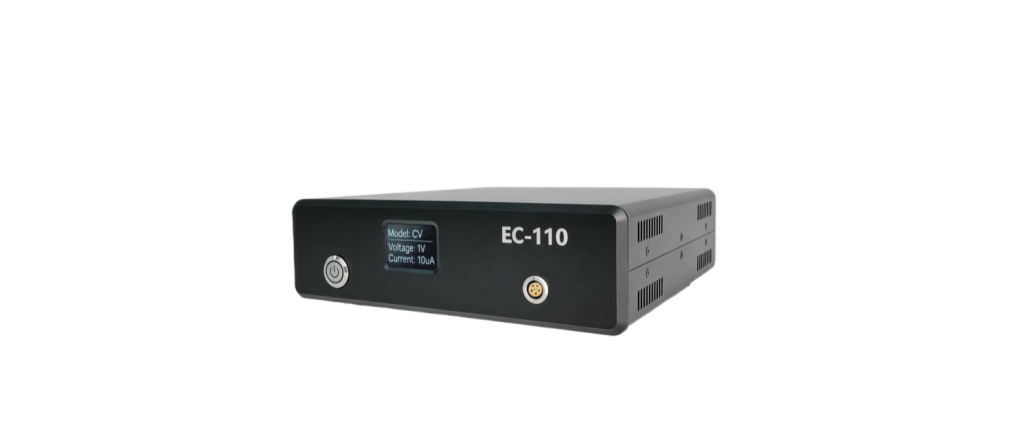
Research-grade electrochemical workstation
Available in three models: EC-110, EC-110 Plus, and EC-110 Pro.
OVERVIEW
Product Features
01
pA-level current noise with detection capability down to tens of pA. Current ranges from 1 nA to 250 mA with automatic range switching, enabling precise measurements across a wide dynamic range.
02
Supports both positive-feedback and dynamic iR compensation, improving measurement accuracy and reproducibility across a wide range of electrochemical experiments.
03
Features 16-bit ADC acquisition at 1 MHz or 3 MHz with high-speed USB 2.0 communication, ensuring fast, stable, and reliable data acquisition and transfer.
Potentiostat Specifications
| Item | Parameter |
| Maximum potential range | ±10 V |
| Maximum current | ±250 mA continuous; ±350 mA peak |
| Compliance voltage | ±13 V |
| Potentiostat rise time | <1 μs, typically 0.8 μs |
| Potentiostat bandwidth (−3 dB) | 3 MHz |
| Applied potential ranges | ±10 mV, ±100 mV, ±1 V, ±10 V |
| Applied potential resolution | ≤0.0015% of the potential range |
| Applied potential accuracy | ±1 mV; ±0.1% FSR |
| Applied potential noise | <10 μV RMS |
| Measured current range | ±10 pA to ±0.25 A, 10 ranges |
| Measured current resolution | 0.0015% of the current range |
| Current measurement accuracy | 0.2% at current sensitivities from 1 × 10⁻³ to 1 × 10⁻⁷ A/V; 1% for other ranges |
| Input bias current | <10 pA |
Galvanostat Specifications
| Item | Parameter |
| Applied current range | 3 nA–250 mA |
| Applied current accuracy | 0.2% for currents above 3 × 10⁻⁷ A; 1% for other ranges; ±20 pA |
| Applied current resolution | ≤0.03% of the current range |
| Measured potential range | ±10 V |
Electrometer Specifications
| Item | Parameter |
| Reference electrode input impedance | 1 × 10¹² Ω |
| Reference electrode input bandwidth | ≥25 MHz |
| Reference electrode input bias current | ≤10 pA @ 25°C |
Waveform Generation and Data Acquisition
| Item | Parameter |
| High-speed waveform generation update rate | 100 MHz, 14-bit resolution |
| High-speed data acquisition | Better than 16-bit resolution; simultaneous dual-channel sampling at 3 million samples per second |
| Maximum sampling rate of the external signal recording channel | ≥1 MHz |
Product model
| Function | EC-110 | EC-110 plus | EC-110 Pro |
|---|---|---|---|
| Cyclic voltammetry (CV) | ● | ● | ● |
| Linear Sweep Voltammetry (LSV) | × | ● | ● |
| Step-sweep voltammetry (SCV) | × | × | ● |
| Tafel diagram (TAFEL) | × | ● | ● |
| Chronoamperometry (CA) | ● | ● | ● |
| Chrono-Coulometry (CC) | ● | ● | ● |
| Differential pulse voltammetry (DPV) | × | ● | ● |
| Normal Pulse Voltammetry (NPV) | × | ● | ● |
| Differential normal pulse voltammetry (DNPV) | × | × | ● |
| Square Wave Voltammetry (SWV) | × | × | ● |
| Alternating Current (including phase sensitive) Voltammetry (ACV) | × | × | ● |
| Second harmonic alternating current (phase sensitive) voltammetry (SHACV) | × | × | ● |
| Fourier Transform Alternating Current Voltammetry (FTACV) | × | × | ● |
| Current-time curve (i-t) | ● | ● | ● |
| Differential pulse amplitude detection (DPA) | × | × | ● |
| Double Differential Pulse Amplitude Detection (DDPA) | × | × | ● |
| Three-pulse Amperage (TPA) | × | × | ● |
| Integral Pulse Amplitude Detection (IPAD) | × | × | ● |
| Controlled potential electrolysis coulometry (BE) | ● | ● | ● |
| Hydrodynamic Modulation Voltammetry (HMV) | × | × | ● |
| Scan-Step-and-Fuse (SSF) method | × | × | ● |
| Potentiostatic Intermittent Titration (PITT) | × | × | ● |
| Impedance measurement (IMP) | × | ● | ● |
| AC impedance measurement (constant current control) | × | × | ● |
| Impedance-measurement over time (IMPT) | × | ● | ● |
| Impedance-Potential Measurement (IMPE) | × | ● | ● |
| Chronopotentiometry (CP) | ● | ● | ● |
| Current scanning chronopotentiometry (CPCR) | × | × | ● |
| Multiple current step method (ISTEP) | ● | ● | ● |
| Galvanostatic Titration Technique (GTT) | × | × | ● |
| Potentiometric stripping analysis (PSA) | × | × | ● |
| Electrochemical Noise Measurement (ECN) | × | × | ● |
| Open-circuit potential-time curve (OCPT) | ● | ● | ● |
| Constant current instrument | ● | ● | ● |
| RDE control (0-10V output) | × | × | ● |
| Arbitrary reaction mechanism CV simulator | × | × | ● |
| Preset reaction mechanism CV simulator | ● | ● | ● |
| Digital simulator and fitting program for AC impedance | × | ● | ● |
RESOURCES
RELATED PRODUCTS
OPTICAL INSTRUMENT